
EdTech
Your EdTech Product Proves Engagement. The District Wants Proof of Learning.
September 29, 2026
by
Neocoast

A product gets adopted in a pilot.
Usage looks great. Students log in. Time-on-task is up. The dashboard is full of green.
Then the renewal conversation starts.
The question changes. It's no longer "are students using it?" It's "are students learning more because of it?"
And the product cannot answer.
In 2026, districts are not buying features. They are buying evidence that a product improves learning. If your product cannot show that, it does not matter how good the engagement numbers look.
The problem is that most EdTech products are built to measure usage, because usage is easy to measure.
Proving learning outcomes is harder, and it has to be designed into the product from the start. It cannot be added the week before a renewal meeting.
What are districts actually asking for before they buy?
The buyer changed. Budgets are tighter, ESSER relief funding is gone, and districts are consolidating the tools they already have instead of adding new ones.
That shift moved the conversation from "what should we adopt?" to "what is worth keeping?"
Worth keeping means something specific now. It means the product can show a connection to learning, not just activity.
Districts have learned to be skeptical of vanity metrics. Number of logins. Clicks. Minutes in the app.
Those numbers tell a district that students opened the tool. They say nothing about whether the tool helped.
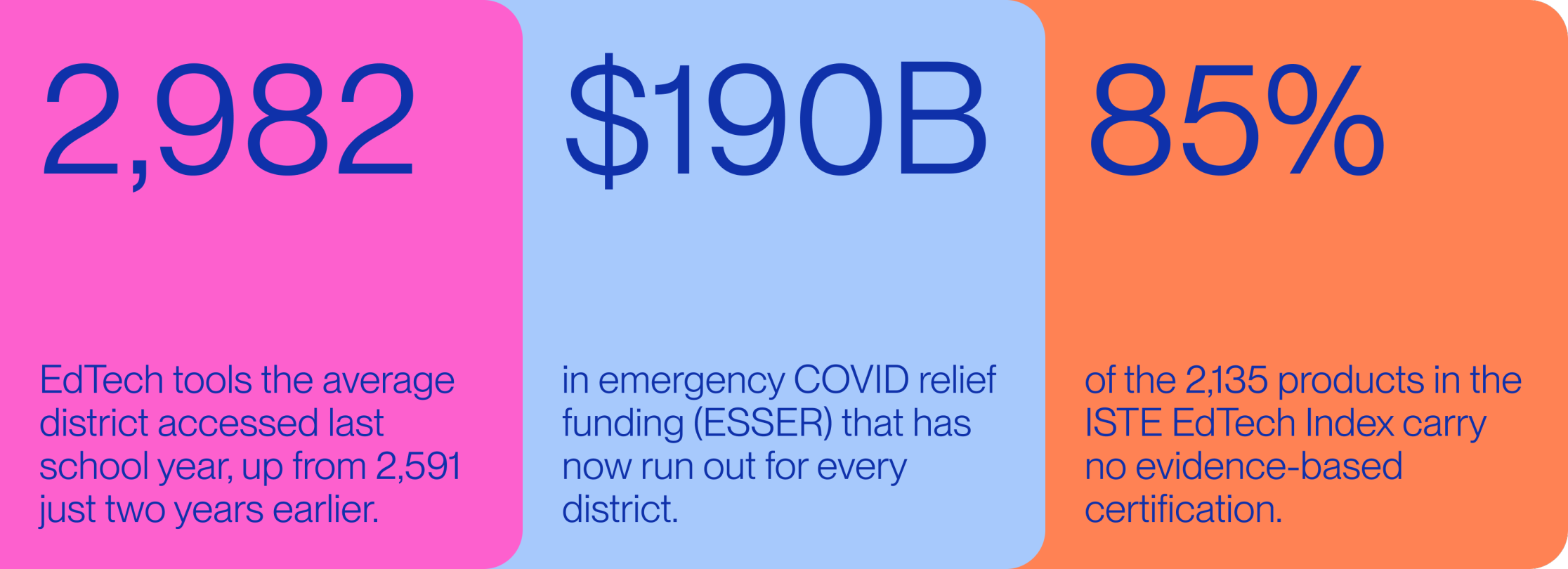
So when a district asks a vendor to prove impact, a wall of engagement data is the wrong answer. It signals that the product measured what was easy instead of what mattered.
Why can't most products prove learning outcomes?
Because outcome measurement is an architecture decision, and it usually gets made too late.
Think about what proving a learning outcome requires.
You need a baseline: some measure of where a student started.
You need to track a meaningful signal over time, not just activity.
You need that data structured in a way that a district can actually read and trust.
And you need all of it to respect student data privacy, because the moment you are collecting learning data you are deep in FERPA territory.
None of that is a feature you bolt on later. It shapes the data model. It shapes what events the product captures from day one. It shapes how the reporting layer is built.
A team that has not built EdTech before will usually optimize for the demo. The demo rewards engagement metrics, because engagement is visual and immediate and looks impressive in a room. Learning outcomes are slower, quieter, and harder to show in a five-minute pitch.
So they get deprioritized, and the product ships without the plumbing to measure what the district will eventually ask about.
Then the renewal comes, and the plumbing is not there.
How do you design a product that can prove impact from day one?
You start by deciding, before writing code, what learning outcome the product is responsible for.
Not engagement. The actual thing a student should be able to do differently after using it.
Once that is clear, a few decisions follow.
Capture a baseline
If you never measured where a student started, you can never show movement. Baseline capture has to be built into the first-run experience, not requested after the fact.
Measure a signal that maps to learning
Pick a signal that connects to the outcome, and instrument it from the start. Mastery of a skill, growth on an assessment, progression through a sequence.
Something a district can tie back to their own goals.
Build the reporting layer for the buyer, not the demo
The person who needs the impact data is often a district admin who has to justify the spend. Design the reports for that person: clear, exportable, and honest about what the data does and does not show.
Structure the data for privacy from the beginning
Learning data is student data. How it is collected, where it lives, and who can see it are FERPA questions, and they affect the data model directly.
Handle this at the architecture stage and it becomes a selling point. Handle it late and it becomes a rebuild.
"They're part of the team, and they're core to our continued success." — Michael Manley, CTO, ThinkCERCA, talking about working with Neocoast.
Over ten years building EdTech products across K-12 and higher education, the pattern we keep seeing is this: the products that survive the renewal conversation are the ones that decided early what learning they were responsible for, and built the measurement in from the start.
Before you build, ask your team:
- What specific learning outcome is this product responsible for, in one sentence?
- How will you capture a baseline before a student starts?
- What signal will you measure that a district can tie to their own goals?
- Who reads the impact report, and is it built for that person?
- Is the outcome data structured to respect FERPA from the first line of code?
Engagement gets you through the pilot. Evidence of learning gets you the renewal.
If you are building an EdTech product and thinking about how to prove it works, we are happy to talk through what that looks like for you.


