
Sofware Development
News
EdTech
EdTech Products Are Built for Ecosystems, Not Just Users
July 20, 2026
by
Neocoast

A product can look great in a demo.
The flow is smooth. The interface is clean. The core features work. Everyone in the room nods.
Then the pilot starts.
A teacher opens it on a school network. Students are using Chromebooks. The LMS integration is not ready. IT asks about data governance. Procurement wants documentation. The district admin needs permissions that were never designed.
And suddenly, the product that looked ready is not really ready.
That is the difference between good software and EdTech-ready software.
Good software works.
EdTech-ready software works inside the reality of schools, districts, universities, teachers, students, admins, IT teams, procurement processes, compliance requirements, and integrations.
That is a very different thing to build.
At Neocoast, we have spent over ten years building EdTech products across K-12 and higher education. And if there is one thing that experience has made clear, it is this: the hardest parts of EdTech are not always the features themselves.
They are the context around the features.
The EdTech market is asking harder questions
District technology leaders in 2026 are under more scrutiny than they have been in years.
ESSER federal relief funding is gone. Budgets are tighter. School boards are asking harder questions. Districts are consolidating platforms instead of adding new ones.
The question has shifted.
It is no longer just:
“Should we adopt this?”
It is:
“Is this worth keeping?”
That shift matters for anyone building an EdTech product.
Districts are evaluating whether a product can prove learning outcomes, whether it meets data governance requirements, whether it integrates with the systems they already use, and whether the vendor can support implementation beyond the demo.
Recent industry reports point in the same direction:
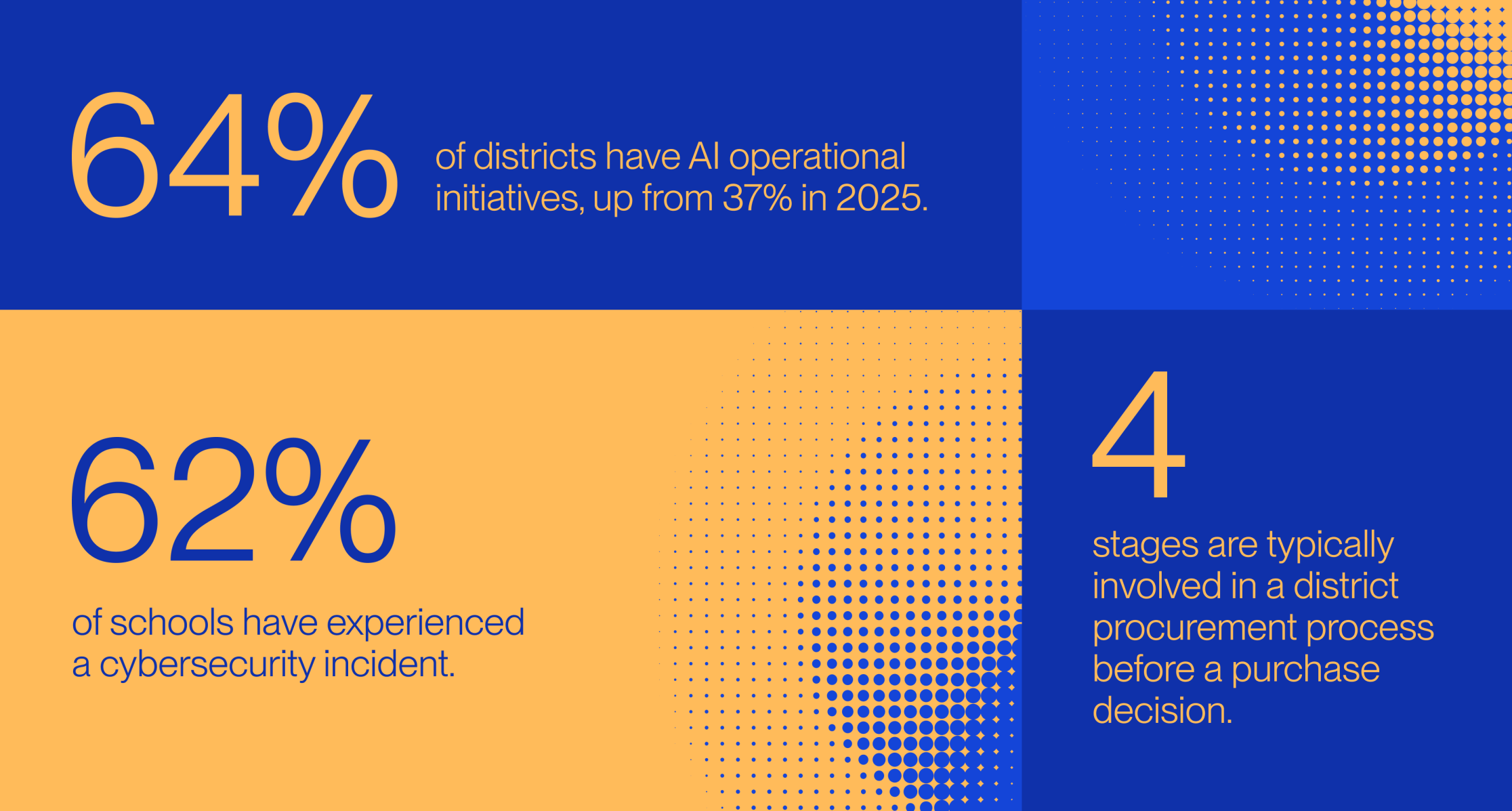
But these are not just market trends to mention in a pitch deck.
They change how the product needs to be built.
If AI is part of the product, data governance cannot be an afterthought.
If cybersecurity is a growing concern, architecture matters from day one.
If procurement is long and layered, implementation planning cannot start after the product is already finished.
That is not only a sales problem.
It is a product problem.
And product decisions made too late are usually the ones that become expensive.
Where strong development teams still get EdTech wrong
A team can build great SaaS, fintech, healthcare, or marketplace products and still underestimate EdTech.
Not because they are not technical enough.
Because they are building for a different environment.
The product was built for the demo, not the classroom
In a demo, everything is controlled.
The internet works. The test users behave. The person presenting knows exactly where to click.
A classroom is not that.
A classroom is 28 students on different devices, a teacher with limited time, a school network with restrictions, and an IT team that has locked down parts of the experience.
The real test is not whether the product works when everything goes right.
It is whether it still works when the school environment behaves like a school environment.
Compliance was treated like a checkbox
FERPA, COPPA, state privacy laws, consent, permissions, reporting, and data governance are not final-step details.
They affect what data is collected, where it lives, who can see it, how roles are structured, how reports are generated, and how integrations work.
If those decisions happen too late, the team usually has to rebuild parts of the product that should have been designed correctly from the beginning.
That is expensive, slow, and one of the reasons products lose momentum before they scale.
Integrations were left for later
“We’ll add the LMS integration after launch” sounds reasonable until the first serious pilot conversation.
Then Canvas matters.
Or Clever.
Or OneRoster.
Or Google Classroom.
Or the district’s specific SIS setup.
A product can have the right features and still get blocked if it cannot connect to the systems schools already rely on.
In EdTech, integrations are not always an add-on.
Sometimes, they are what makes adoption possible.
The product was built for one user, but EdTech has many
Who is the user?
In EdTech, that question is rarely simple.
The student may be the end user. The teacher may be the daily user. The school admin may manage setup. The district admin may need reporting. IT may control access. Procurement may control the purchase. Leadership may care about outcomes.
If the product is designed for only one of them, the others usually feel the friction.
And that friction shows up during pilots, support tickets, low usage, and renewals that never happen.
What changes when your development team understands EdTech
When a development team has worked inside EdTech before, the questions change from the first sprint.
Not just:
Can we build this?
But:
How will this work when a district admin needs to configure it for 200 teachers across five schools?
How should this data be structured so it satisfies FERPA and still gives teachers useful insights?
What happens when the school network blocks part of the experience?
Will this workflow save teachers time, or quietly add another step?
Can this survive implementation, not just the demo?
This is where EdTech experience changes the quality of the product.
It helps teams identify risks earlier.
It helps avoid rework.
It helps founders make better roadmap decisions.
It helps technical teams design with compliance, integrations, and adoption in mind from the beginning.
And it helps the product move from a promising demo to something schools can actually use.
“Neocoast has a deep understanding of the complex ecosystem of needs that EdTech companies face. In terms of relationships, communication, and ownership, we couldn't ask for a better group of people.” - Eileen Murphy, Founder & CEO, ThinkCERCA
Over ten years building EdTech products across K-12 and higher education, the most valuable thing we have accumulated is context.
Context to know when something looks good in a roadmap but will create friction in a classroom.
Context to identify risks before they become pilot blockers.
Context to push back when a decision will not survive real implementation.
Because in EdTech, what happens after the demo matters as much as the demo itself.
Before choosing an EdTech development partner, ask this
Not just:
Can they build the product?
Ask:
- Have they built products that integrate with Canvas, Clever, OneRoster, or Google Classroom?
- Do they understand FERPA, COPPA, and district-level data privacy requirements in practice, not just in theory?
- Have they supported a product beyond MVP and into pilot or scale?
- Can they challenge product decisions based on actual classroom and district realities?
- Do they understand the difference between a buyer, an admin, a teacher, and a student, and design for all of them?
- Can they help you make better product decisions before those decisions become blockers?
Shipping the product is only part of the job.
The real question is whether the product is ready for what happens next: the pilot, the implementation, the integrations, the procurement process, the classroom, the renewal conversation, and the district rollout.
That is where EdTech products prove whether they were built for a demo or built for the ecosystem they need to survive in.
And that is the kind of product we help build at Neocoast.


