
Sofware Development
News
EdTech
Data governance is an architecture decision, not a compliance checklist
September 9, 2026
by
Neocoast

Four months into building an EdTech platform, the team is moving fast.
Teachers can create classes, students can submit work and the progress dashboard looks good in demos.
Then a district technology director asks one question on a pilot call: if a student transfers out mid-year, how fast can you delete their data, and can you prove it?
Nobody on the call has a real answer.
The data model was never built to answer it.
Fixing this now doesn't mean a patch.
It means touching the schema, the API, half the codebase.
What does data governance actually mean for an EdTech product?
It means knowing, at the schema level, who owns each piece of student data, how long it's retained, where it can travel, and how it gets deleted on request.
It's not a policy document.
It's a property of how the product is built, the same way security or scalability are.
Most software categories can leave this to a policy doc that legal maintains on its own.
EdTech doesn't get that option. FERPA and COPPA set a federal floor, state-specific student privacy laws add more specific technical demands on top of it, and procurement teams now ask about all of it directly, not just legal.
Which data decisions have to happen before writing any code?
The ones that are expensive to change later: who owns a record, how data gets scoped when a student moves between schools, and what "delete" actually means once backups, logs, and analytics pipelines exist.
Get these wrong on day one, and every feature built after inherits the problem.
- Ownership: does the district or the school control the record?
- Portability: what happens to a student's data when they transfer?
- Deletion: does "delete" mean gone, or just gone from the UI?
- Retention: how long does data live after a contract ends?
Which laws actually shape the architecture?
FERPA and COPPA are federal, and they set a floor. The heavier lift on deletion and retention sits with state-specific student privacy laws, more than a hundred of them, each with its own rules. Getting the architecture right means satisfying whichever state law actually applies, since FERPA and COPPA alone rarely cover it.
FERPA governs who can access a student's education record and requires an audit trail of disclosures. The district is the party that answers to FERPA directly.
A vendor takes on those obligations through its contract with the district, the DPA, acting as what FERPA calls a "school official." Compliance happens inside that agreement.
COPPA adds separate, federal rules for anything touching kids under 13, including how consent gets captured and what a company can do with that data at all.
State laws are where deletion and retention actually get tested. California has SOPIPA. Illinois has SOPPA. There are more than a hundred similar laws across other states, each with its own definition of deletion and its own timeline.
We track these directly for clients instead of stopping at FERPA and COPPA, because the district on a pilot call is usually asking about their own state's law first.
None of these laws tell you how to build your database. All of them make certain shortcuts, shared logins, undifferentiated data lakes, vague consent flows, unworkable once a district actually asks.
That range is why we run a dedicated compliance practice around it.
Implementation from scratch.
Audit and readiness.
Ongoing compliance across our EdTech and HealthTech clients.
What it looks like in practise:
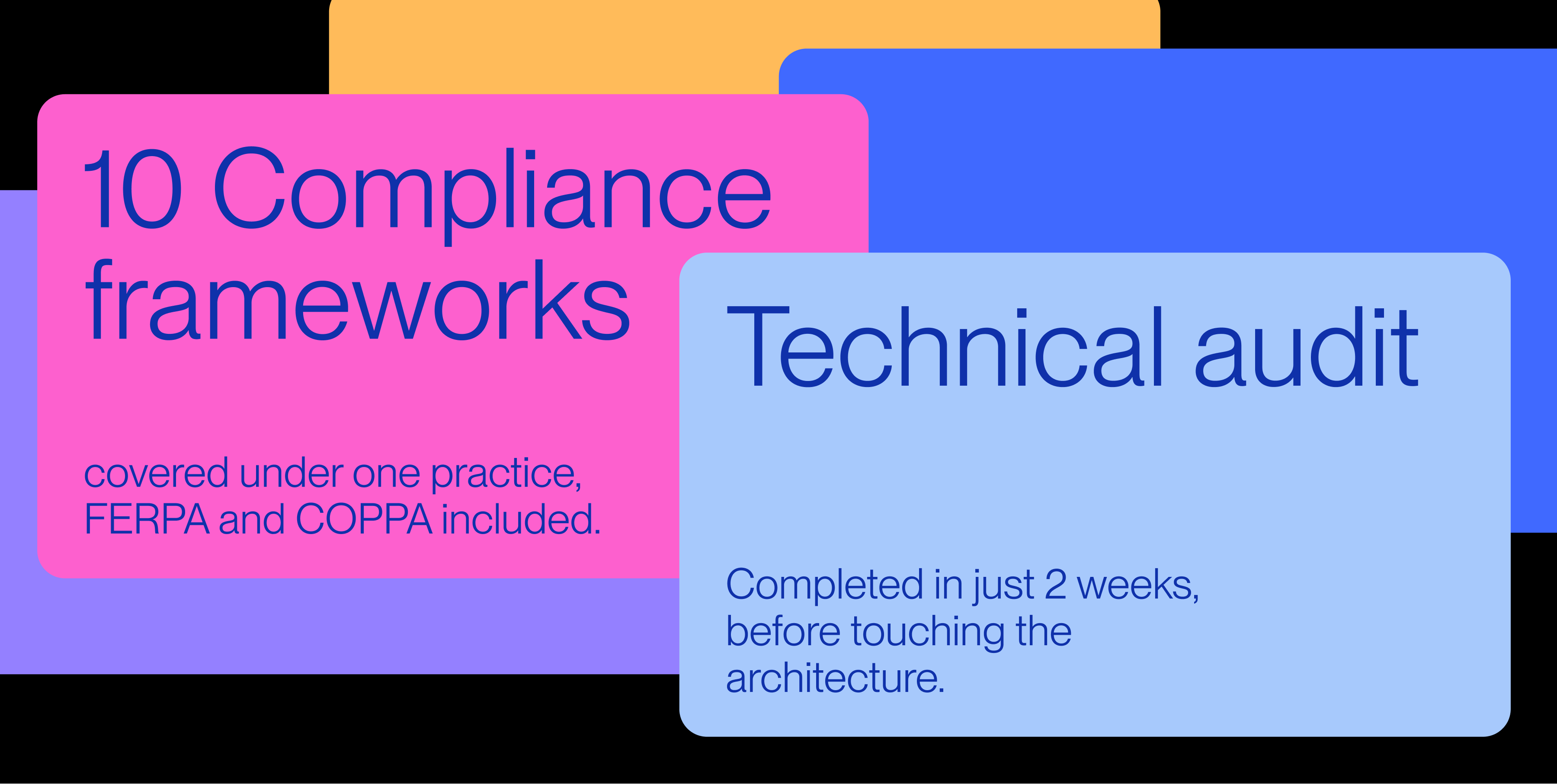
That's not a side offering.
It exists because the gap between privacy language on a terms-of-service page and actually passing procurement is usually architectural, not legal.
Why does adding AI make an ungoverned data model worse?
AI features need training or context data pulled from somewhere.
If the underlying data isn't already governed, AI doesn't just inherit that problem, it becomes a new, harder to audit version of it.
District buyers evaluating AI features now ask where the model gets its data and whether that data was ever meant to be used that way. A product without a governance answer stalls right there, before the demo even matters.
What this looks like when it's done early:
One of our clients, a K-12 EdTech platform, hit this wall directly. Their user base grew. Schools leaned harder on the platform for decisions. The legacy data architecture couldn't keep up.
We ran a two-week technical audit first, not a rebuild.
Then refactored the business logic into a Node.js microservice architecture and shipped the Insights Hub, one centralized dashboard giving schools a single source of truth instead of scattered reports.
"Neocoast demonstrated a complete understanding of the processes, had good vision, used effective tools, and made communication easy." — Customer Service, Client
The teams that get this right don't treat governance as the last mile before launch.
They treat it as one of the first three or four decisions in a new build, right up there with LMS integration and multi-role access.


