
Software Development
News
EdTech
Before the Features: What 50 EdTech RFPs Reveal About Compliance
November 16, 2026
by
Neocoast

50 RFPs. 43 buyers. 25 states.
We read every page.
The shortest one had 4 pages. The longest had 531.
And one pattern kept showing up: before schools, universities, and workforce programs can focus on what your product does, they need to know whether it meets their requirements.
Accessibility. Student data privacy. Security. Rules for AI.
In many procurement processes, these aren't just nice-to-have features. They can determine whether a vendor moves forward in the evaluation.
They're part of the entry ticket.
Why we looked at 50 EdTech RFPs
At Neocoast, we've spent ten years building software alongside EdTech companies. Understanding what schools, districts, and institutions actually expect helps us make better product decisions with our clients.
And what better way to understand those expectations than looking at what buyers put in writing?
We analyzed 50 publicly available RFPs from 43 buyers across 25 US states, covering K-12, Higher Education, and Workforce Learning.
Each document was reviewed against 30 variables, including privacy, accessibility, security, AI, integrations, and procurement criteria.
Here's what we found.
1. What compliance requirements do EdTech RFPs include?
When an EdTech company prepares to sell to a school or university, the conversation often starts with the product.
What does it do? How does it improve learning? What makes it different?
But public buyers also have legal, technical, and operational requirements they need vendors to meet.
And in some RFPs, those requirements can be conditions for moving forward, regardless of how strong the product's features are.
We tracked six compliance requirements that appeared repeatedly:
- Student data agreements: Contracts that define how vendors can use, store, and delete student information.
- WCAG 2.1 or higher: Accessibility standards for digital products.
- VPATs: Documents describing how a product conforms to accessibility standards.
- US-based student data storage: Requirements to keep student data within the United States.
- Cyber insurance: Coverage against specified cybersecurity risks.
- Security certifications: Evidence of recognized security practices and controls.
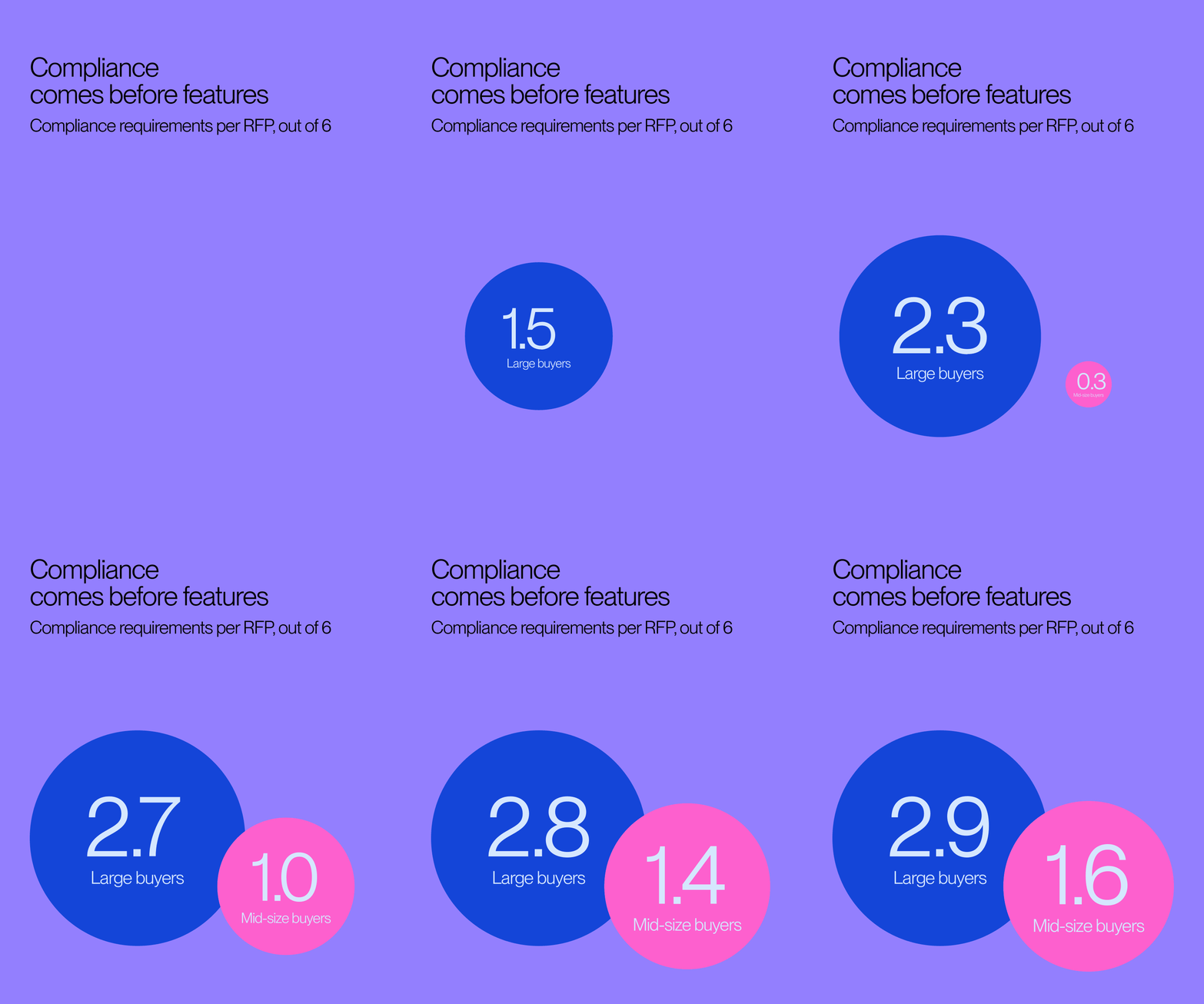
One finding stood out: larger buyers tended to ask for more.
Large buyers requested an average of 2.9 of these six requirements per RFP, compared with 1.6 for mid-sized buyers.
Small buyers averaged 1.0, although that group included only three RFPs, so the result is less conclusive.
For EdTech companies looking to move into larger districts or institutions, this matters.
Scaling into a new market isn't always just about adding features or supporting more users. It may also mean meeting a more demanding set of compliance expectations.
And many of those requirements take time to address.
2. How do EdTech RFP requirements differ across K-12, Higher Ed, and Workforce?
Compliance doesn't look the same across K-12, Higher Education, and Workforce Learning.
While some requirements appear across all three, the priorities change depending on who's buying.
K-12: Student data privacy stands out
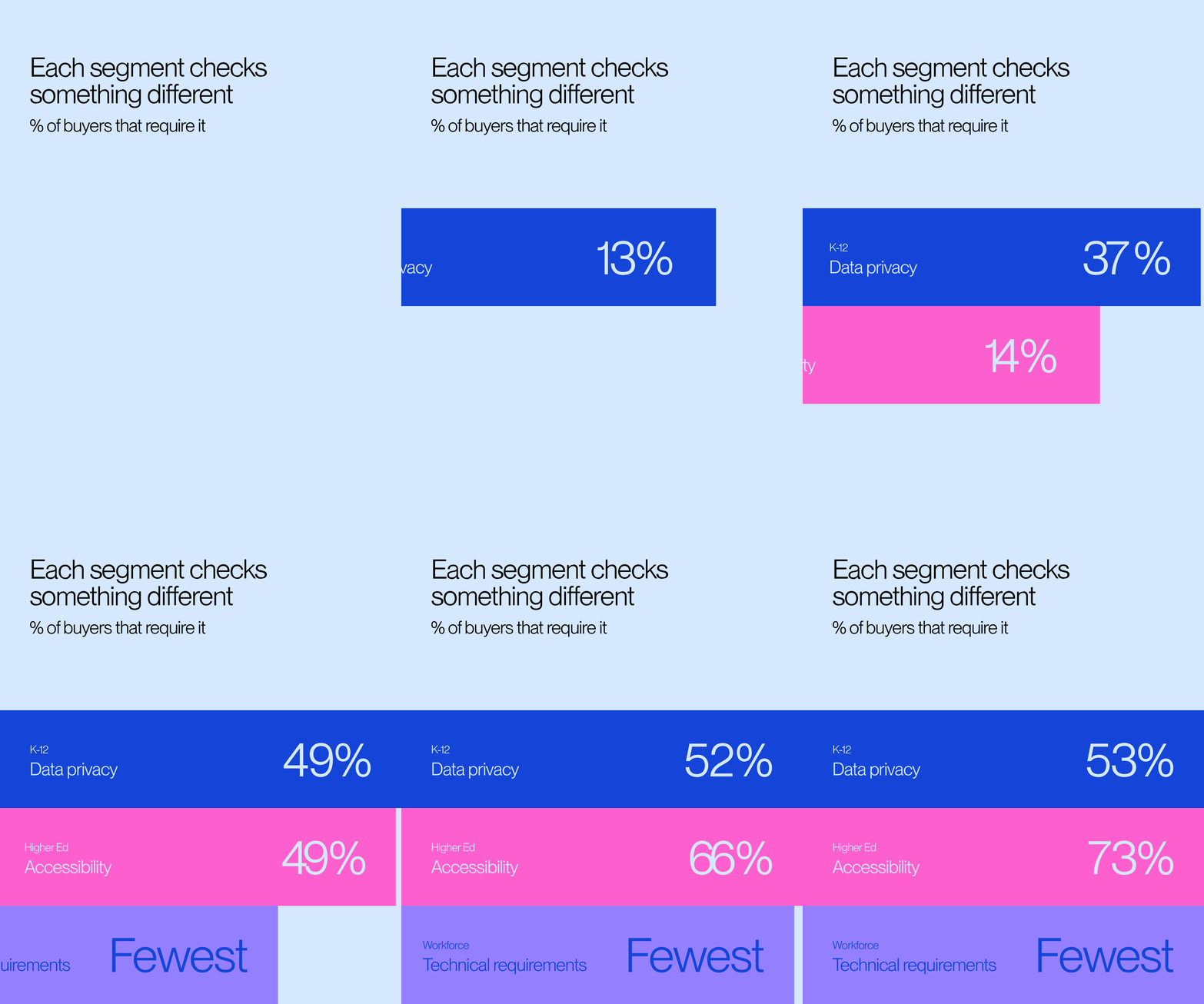
In our sample, 53% of K-12 buyers required a student data privacy agreement.
Another 47% specified that student data needed to be stored in the US.
For companies building products for schools and districts, this means thinking carefully about how student information is collected, stored, shared, and protected.
Integrations matter, too. 63% of K-12 buyers requested automatic rostering through standards or platforms such as OneRoster, Clever, or ClassLink.
A product might deliver a great learning experience, but it still needs to work within the district's existing systems and data requirements.
Higher Education: Accessibility stands out
Among Higher Ed buyers, 73% required WCAG 2.1 or higher, and 64% requested a VPAT.
These numbers show just how important it is for universities to understand whether a product can be used by students with different accessibility needs.
Integrations were another major requirement, with 91% of Higher Ed buyers asking for LMS integration.
For EdTech companies selling to universities, accessibility and interoperability need to be considered early in product development.
Workforce Learning: Fewer technical requirements, but accessibility still matters
Workforce Learning buyers generally requested fewer technical integrations and compliance items in our sample.
However, 57% required WCAG 2.1 or higher.
Credentials and certificates were another recurring priority, reflecting the importance of documenting skills and learning achievements.
The point isn't that one segment is easier than another.
It's that the requirements your product needs to meet depend heavily on who you're selling to.
3. Accessibility is becoming harder to overlook
Of all the compliance topics we analyzed, accessibility deserves particular attention.
It's a recurring procurement requirement, and the regulatory landscape is reinforcing its importance.
Under the US Department of Justice's ADA Title II web accessibility rule, covered public entities must ensure that applicable web content and mobile applications meet WCAG 2.1 AA, including content and apps made available through vendors.
Following an extension published in April 2026, compliance deadlines are generally April 26, 2027, for public entities with populations of 50,000 or more, and April 26, 2028, for smaller entities and special district governments.
Some of the RFPs we analyzed already had particularly strict accessibility expectations.
At the University of Central Arkansas, WCAG 2.2 AA accessibility accounted for 40 of 300 points in its LMS evaluation.
At Texas A&M University-Corpus Christi, the RFP included contractual consequences for accessibility noncompliance that wasn't resolved.
And Durham Public Schools required evidence of existing accessibility compliance rather than accepting a future remediation plan.
These examples show why accessibility can't always be treated as something to address after a product is built.
For EdTech teams, designing and developing with accessibility in mind from the beginning can make a real difference when procurement opportunities arise.
4. AI isn't necessarily a barrier, but buyers want safeguards
AI was another interesting finding.
None of the 50 RFPs we analyzed explicitly banned AI.
In fact, 64% of Higher Ed buyers requested AI capabilities.
K-12 buyers were more cautious.
About one in three established specific conditions for AI use, including:
- Not training models on student data
- Giving schools the ability to disable AI features
- Requiring human review of AI-generated content
- Checking for bias and inaccurate outputs
The takeaway isn't that public education buyers don't want AI.
They want to know how it's being used, what data it accesses, and what safeguards are in place.
And those safeguards aren't just procurement documentation.
They involve real product decisions around architecture, data handling, permissions, and user experience.
They're easier to plan during development than to add just before an RFP deadline.
5. Why preparing before the RFP matters
Across the 46 RFPs with clear response deadlines, vendors had a median of approximately 30 days to submit their proposals.
Eleven allowed three weeks or less, and four allowed two weeks or less.
That's not much time to address major product gaps.
Accessibility, security requirements, privacy agreements, integrations, and AI safeguards often require work that extends well beyond the proposal-writing process.
And buyers don't only want documentation. They may also want to see the product working.
Required demos or sandboxes appeared among 47% of K-12 buyers and 36% of Higher Ed and Workforce buyers in our sample.
There's also more to evaluation than price.
Among the 31 RFPs that published their scoring criteria, price accounted for a median of just 20% of the total score.
Product capabilities, implementation approach, experience, and other requirements accounted for the rest.
All of this reinforces the same idea: the work that helps an EdTech company compete starts long before the RFP is published.
What should an EdTech company have ready before its next RFP?
The answer depends on your target market, but our research points to a few priorities worth reviewing early.
If you sell to K-12
- Student data privacy agreements and appropriate data storage arrangements
- Automatic rostering through standards or platforms such as OneRoster, Clever, or ClassLink
- Clear AI safeguards, including controls over student data
- Cyber insurance where required
If you sell to Higher Education
- Accessibility aligned with WCAG requirements and up-to-date conformance documentation
- LMS and student information system integrations
- Clear AI safeguards, including controls for bias and inaccurate outputs
If you sell to Workforce Learning
- Accessibility requirements relevant to your buyers
- Capabilities for issuing credentials or certificates where needed
And across all three segments, having a working demo or sandbox ready can help buyers evaluate your product.
Not every company needs every certification, integration, or document from day one.
But understanding what your buyers expect makes it easier to prioritize what to build, improve, and document.
The RFP isn't where preparation begins
An RFP tells you what a buyer is looking for.
But by the time it's published, many of the decisions that determine whether your product is ready to compete have already been made.
That's why understanding procurement requirements matters beyond the sales process.
At Neocoast, we've spent ten years working alongside EdTech companies to build and improve their products.
Accessibility, data privacy, integrations, security, and responsible AI are all considerations that shape how we approach development.
And understanding what buyers actually expect helps us make better product decisions together with our clients.
The RFP may be when your product gets evaluated. The work that helps you compete starts much earlier.
Want to compare notes on what public education buyers expect? We'd love to hear from you.
We'll also be sharing more findings from this research over the coming weeks, including a closer look at AI requirements, procurement timelines, and what larger buyers expect.
About the research
Neocoast analyzed 50 publicly available EdTech RFPs published between May 2025 and October 2026.
The sample covered 43 buyers across 25 US states, across K-12, Higher Education, and Workforce Learning. Segment percentages were calculated per buyer, while price weighting and response times were calculated per RFP.
This was a limited, non-representative sample of publicly accessible RFPs. The findings reveal patterns within those documents, not definitive requirements or market-wide estimates for all US education buyers.
Sources
- Neocoast analysis of 50 public EdTech RFPs.
- US Department of Justice, ADA Title II Web Accessibility Rule: https://www.ada.gov/resources/2024-03-08-web-rule/


